
Full Example: Database
The Database page is a photo gallery built on the Skapi database. Every post is a record with an image file, a description and tags, and the page shows how records are uploaded with files, queried in different orders and connected to each other. It needs a logged-in user.
Enter your project ID to open the demo.
You need your project ID to open the demo.
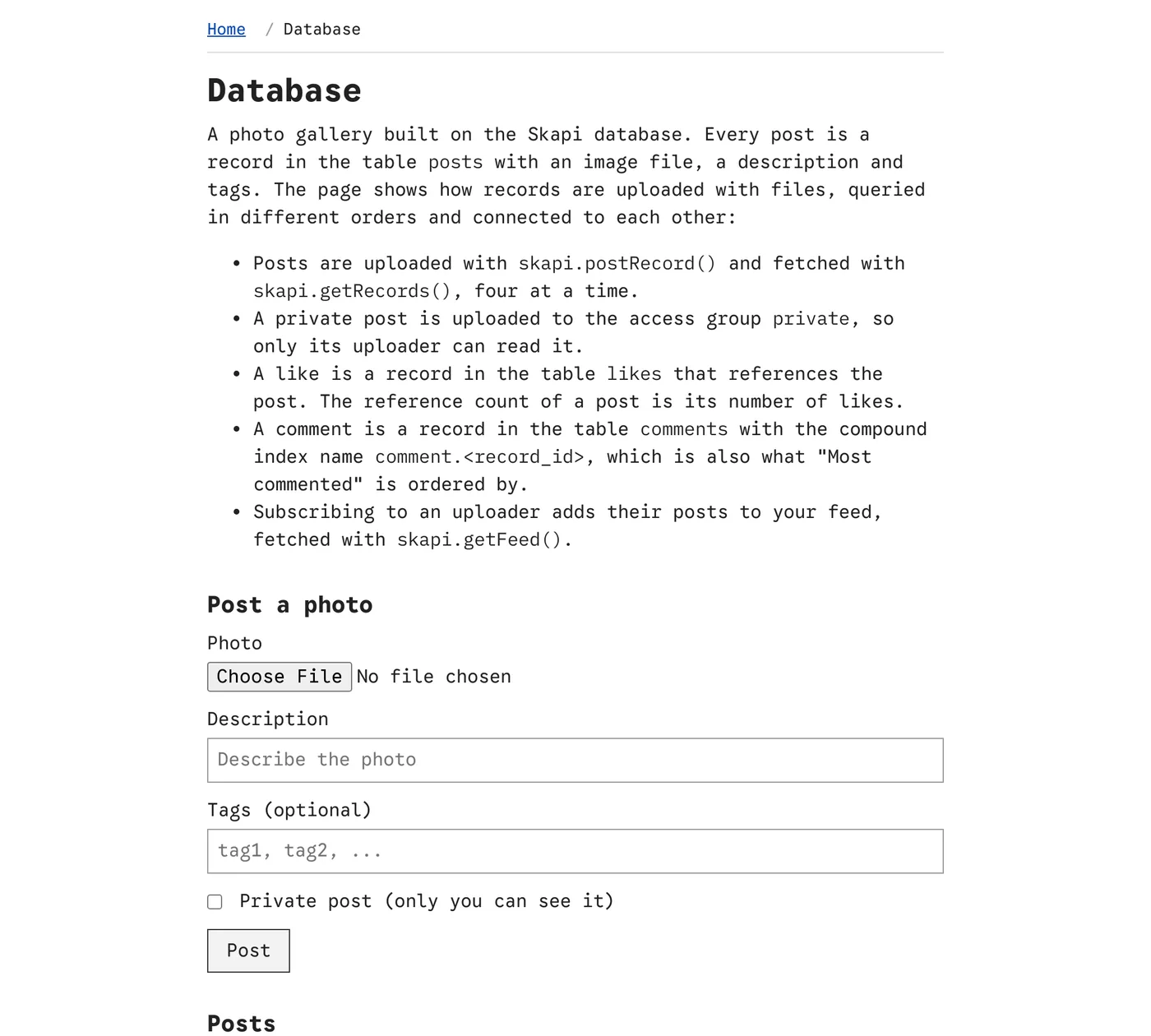
database.html. The form uploads a post with its photo; the Posts section lists them four at a time.
What it demonstrates
| Feature | How the page does it |
|---|---|
| Uploading a post with a file | postRecord() with the form's file input, the description and the tags, in the table posts. The upload progress is shown on the button. See Handling Files. |
| Private posts | A checked "Private" box uploads the post to the access group private, so only its uploader can read it. See Access Restrictions. |
| Listing posts | getRecords() four at a time, newest first, with the fetchMore option behind the "Fetch more posts" button. |
| Most liked | A like is a record in the table likes that references the post, and the post was uploaded with prevent_multiple_referencing, so each user can like it once. The reference count orders the "Most liked" view through the reserved index $referenced_count. See Referencing. |
| Comments and "Most commented" | A comment is a record in the table comments with the compound index name comment.<record_id>, and getIndexes() lists those index names ordered by their totals. |
| My posts, tags | The reserved index $user_id fetches the user's own posts, and a tag in the query fetches the posts with that tag. See Tags. |
| Subscriptions and the feed | Subscribing to an uploader with subscribe() puts their posts in the user's feed, fetched with getFeed(). |
| Deleting a post | deleteRecords() on the user's own posts. |
| Who posted | getUsers() fetches the uploader's and each commenter's profile, cached so every user is fetched once. |
The view is chosen with the URL hash (#mostliked, #mostcomment, #myposts, #myprivate, #feed, #tag=<tag>), so each way of querying is a few lines in one function.
Download
The page is part of the full template: skapi-templates.zip. See Full Examples for how to run it.