
Inviting Users
Admins can invite users to the project by using the inviteUser() method.
When a user is invited, an invitation email is sent to the user with a link to accept the invitation.
In the invitation email, the user will see the login email and randomly generated password, and a link to accept the invitation.
User should click on the link to accept the invitation within 7 days and they will be able to login to the project using the email and password provided in the invitation email. Accepting the invitation verifies the email address, so for an invitation created with a username both the username and the email log the account in from that moment, unless that address is already a login ID another account was granted; see Setting the Invited User's Profile.
Invitations are e-mail sends
Every invitation e-mail counts as one of the project's monthly e-mail sends, the same count a newsletter uses, and a resent invitation counts again. Past the plan's monthly limit an invitation is refused with Monthly email send limit reached. Consider upgrading your plan., and no account is created. A project whose e-mail sending is turned off for spam complaints is refused with E-mail sending is turned off for this project because of spam complaints. The limits per plan are in Sending Newsletters and Plans and Limits.
An AI agent can do this for you. The Skapi MCP server sends, resends, cancels and lists invitations from a prompt, for the project owner and for admins of the project. See Connecting the Skapi MCP server.
This example demonstrates using the inviteUser() method to invite a user to the project. When the request is successful, the string "SUCCESS: Invitation has been sent. (User ID: xxx...)" is returned.
<form onsubmit="skapi.inviteUser(event).then(user => console.log(user))">
    <input name="email" placeholder="E-Mail" required/>
    <input type="submit" value="Invite" />
</form>skapi.inviteUser(
{
email: 'user@email'
},
).then(user => {
console.log(user);
/*
Returns:
"SUCCESS: Invitation has been sent. (User ID: xxx...)"
*/
});TIP
The user will be able to login to the project using the email and password provided in the invitation email. It is recommended to change the password after the first login.
WARNING
An invitation is refused with EXISTS when its email is already a login ID another account was granted, its own login ID or an address it has verified, for example the verified email of a user who was created with a username, and, for an invitation with a username, also when the email is the login ID another account was created with: E-mail "user@email.com" is already a login ID in this service. A username is refused the same way only when it is an e-mail address another account was granted that way: Username "jane@email.com" is already a login ID in this service. An email login another account holds without having verified the address blocks nothing: it is removed, that account keeps logging in with the login ID it was created with, and the invitation goes out. See Login IDs. While an invitation to an email is still pending, a second invitation to that email is refused with User is already invited., whatever the username of either invitation. Once the first invitation was accepted, User is already invited. means the invitation's own login ID (its username, or its email without one) was already used to create or invite another account, and otherwise the result depends on the username of both invitations. See inviteUser() errors, Inviting the same email again and When a login ID is already taken.
For more detailed information on all the parameters and options available with the inviteUser() method, please refer to the API Reference below:
inviteUser(params, options?): Promise<'SUCCESS: Invitation has been sent. (User ID: xxx...)'>
Inviting from the dashboard
Click + Add User on the Users page of your project and choose Send Invitation. Enter the Email, and optionally a Redirect URL to open after the user accepts, a permanent Username, and any profile fields. Click Send Invitation. The account appears in the list once the invitation is accepted.
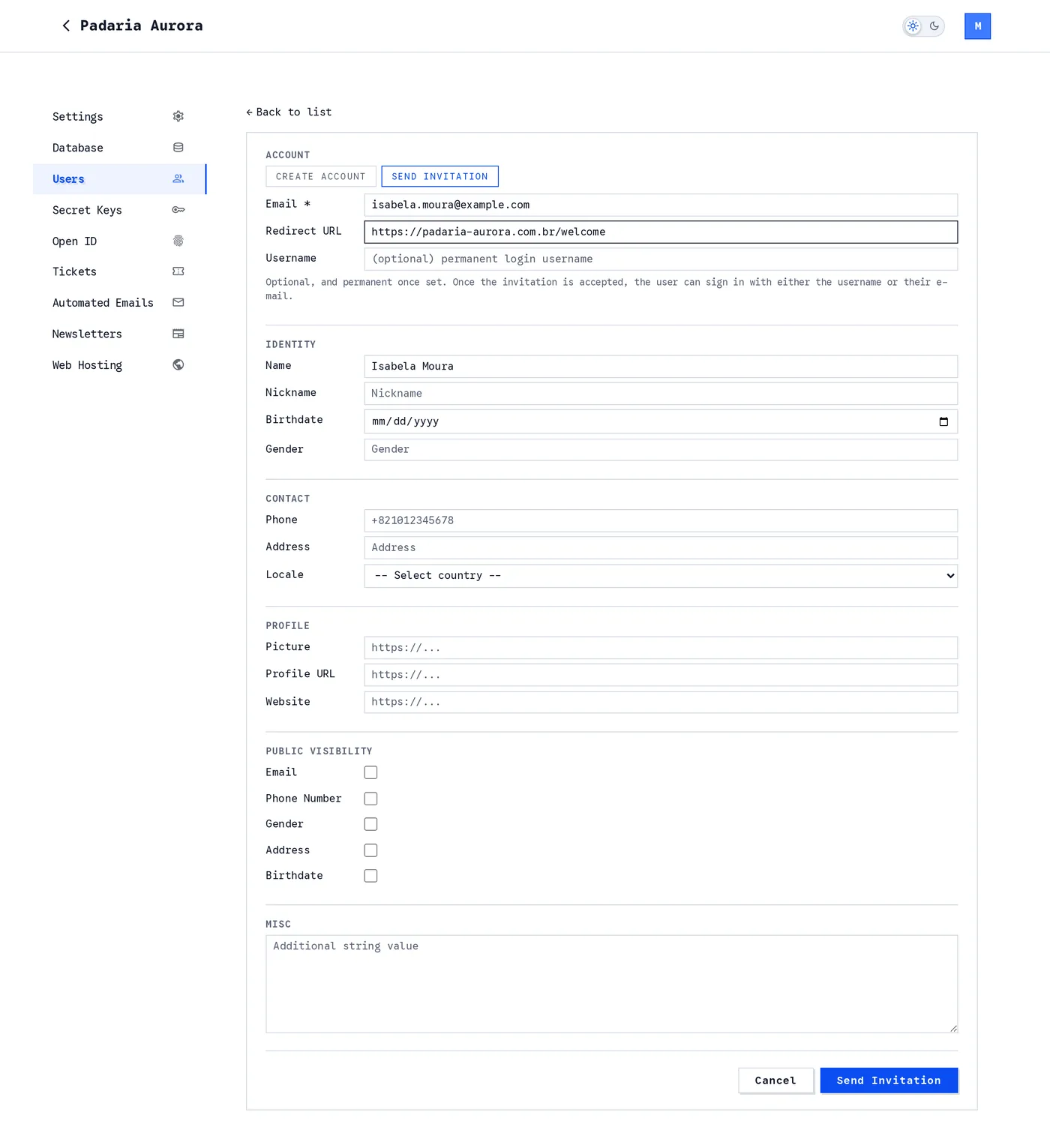
Send Invitation. Skapi emails a temporary password and an acceptance link, and the user has 7 days to accept.
Setting the Invited User's Profile
You can fill in the invited user's profile as part of the invitation. Every attribute you pass is written to the account when the invitation is sent, and it stays as you set it when the user accepts: accepting only activates the account and marks its email verified.
<form onsubmit="skapi.inviteUser(event).then(res => console.log(res))">
    <input name="email" placeholder="E-Mail" required/>
    <input name="username" placeholder="Username (optional)"/>
    <input name="name" placeholder="Name"/>
    <input name="phone_number" placeholder="+0012341234"/>
    <input name="access_group" type="number" min="1" max="99" placeholder="Access Group"/>
    <input type="submit" value="Invite" />
</form>skapi.inviteUser(
{
email: 'user@email.com',
username: 'jane_doe',
name: 'Jane Doe',
phone_number: '+0012341234',
birthdate: '1990-01-01',
access_group: 10
}
).then(res => {
console.log(res);
// SUCCESS: Invitation has been sent. (User ID: xxx...)
});A few of these behave in ways worth knowing:
usernameis optional. When you set one it is the account's permanent login ID and can never be changed. Accepting the invitation verifies the email address, so the email it was sent to logs the account in as well from then on, unless that address is already a login ID another account was granted. While the invitation is pending, the email does not log the account in. See E-Mail and username.access_groupdefaults to1when left out. Set it here to invite someone straight into a higher group instead of granting access after they accept. An admin cannot invite someone into an access group higher than their own.email_publicand the other*_publicflags default tofalse.
To show the username in the invitation e-mail itself, use the optional ${username} placeholder in your template. See Optional placeholders.
Redirecting After Acceptance
Pass confirmation_url to send the user to a page of your own once they accept the invitation. Setting it also lets you subscribe them to Service Email at the same time with email_subscription, which is only accepted together with confirmation_url.
<form onsubmit="skapi.inviteUser(event, {
        confirmation_url: 'https\:\/\/your.website.com/welcome',
        email_subscription: true
    }).then(res => console.log(res))">
    <input name="email" placeholder="E-Mail" required/>
    <input type="submit" value="Invite" />
</form>skapi.inviteUser(
{ email: 'user@email.com' },
{
confirmation_url: 'https://your.website.com/welcome',
email_subscription: true
}
).then(res => {
console.log(res);
// SUCCESS: Invitation has been sent. (User ID: xxx...)
});WARNING
confirmation_url must not contain the # character, and email_subscription without a confirmation_url throws INVALID_PARAMETER.
Send Invitations with Custom Templates
Invitation emails are sent using the default template configured in your Skapi project.
You can use your own custom HTML email template by providing a template URL and custom subject line.
<form onsubmit="skapi.inviteUser(event, {
        template: {
            url: 'https\:\/\/your.custom.template/file.html',
            subject: 'Exclusive Invitation'
        }
    }).then(user => console.log(user))">
    <input name="email" placeholder="E-Mail" required/>
    <input type="submit" value="Invite" />
</form>skapi.inviteUser(
{
email: 'user@email'
},
{
template: {
url: 'https://your.custom.template/file.html',
subject: 'Exclusive Invitation'
}
}
).then(user => {
console.log(user);
/*
Returns:
"SUCCESS: Invitation has been sent. (User ID: xxx...)"
*/
});DANGER
The template must include required placeholders in the HTML content. For more information, see Required Placeholders for Invitation E-Mail.
The optional ${name} and ${username} placeholders are available as well. ${username} renders the account's login username when the invitation was created with one, and the invited person's e-mail address otherwise. A resent invitation renders the same value as the first e-mail; see Resending Invitations for the one exception.
Resending Invitations
Admins can resend invitations to users who have not accepted the invitation by using the resendInvitation() method.
A resent invitation is an e-mail too: it counts as one more of the project's monthly e-mail sends, and past the plan's limit it is refused with the same Monthly email send limit reached. Consider upgrading your plan.
This example demonstrates using the resendInvitation() method to resend an invitation to a user. When the request is successful, the string "SUCCESS: Invitation has been re-sent. (User ID: xxx...)" is returned.
<form onsubmit="skapi.resendInvitation(event).then(user => console.log(user))">
    <input name="email" placeholder="E-Mail" required/>
    <input type="submit" value="Resend Invitation" />
</form>skapi.resendInvitation(
{
email: 'user@email'
},
).then(user => {
console.log(user);
/*
Returns:
"SUCCESS: Invitation has been re-sent. (User ID: xxx...)"
*/
});The resent e-mail carries the same temporary password as the first one and renders ${username} as the first e-mail did: the login username for an invitation created with a username, the email otherwise. The exception is an invitation sent before the backend started keeping the plain username with the invitation: its resend renders the email, even though that address does not log a username invitee in until they accept.
Resending is refused with No invitation found for: user@email.com. (NOT_EXISTS) when no invitation is found for the email, and with User already exists. (EXISTS) when the account found for it is not a pending invitation. Which of the two an accepted invitation gives depends on how it was made: one made without a username gives User already exists., and one made with a username gives No invitation found for: user@email.com. See resendInvitation().
Getting Sent Invitations
Admins can get a list of invitations that have been sent by using the getInvitations() method.
This example demonstrates using the getInvitations() method to get a list of invitations that have been sent. When the request is successful, the DatabaseResponse containing the list of invitations is returned.
The email parameter can be used to filter the invitations by email. When the email parameter is set, only invitations with the email starting with the given string will be returned.
<form onsubmit="skapi.getInvitations(event).then(invitations => console.log(invitations))">
    <input name="email" placeholder="Search for email"/>
    <input type="submit" value="Get Invitations" />
</form>skapi.getInvitations(
{
email: 'user@email'
},
).then(invitations => {
console.log(invitations);
/*
Returns:
{
list: [
{
email: 'user@email',
...
},
...
],
...
}
*/
});For more detailed information on all the parameters and options available with the getInvitations() method, please refer to the API Reference below:
getInvitations(params?, fetchOptions?): Promise<DatabaseResponse<UserProfile>>
Cancelling Invitations
Admins can cancel invitations that have been sent by using the cancelInvitation() method.
This example demonstrates using the cancelInvitation() method to cancel an invitation that has been sent. When the request is successful, the string "SUCCESS: Invitation has been canceled." is returned.
<form onsubmit="skapi.cancelInvitation(event).then(response => console.log(response))">
    <input name="email" placeholder="E-Mail" required/>
    <input type="submit" value="Cancel Invitation" />
</form>skapi.cancelInvitation(
{
email: 'user@email'
},
).then(response => {
console.log(response);
/*
Returns:
"SUCCESS: Invitation has been canceled."
*/
});